

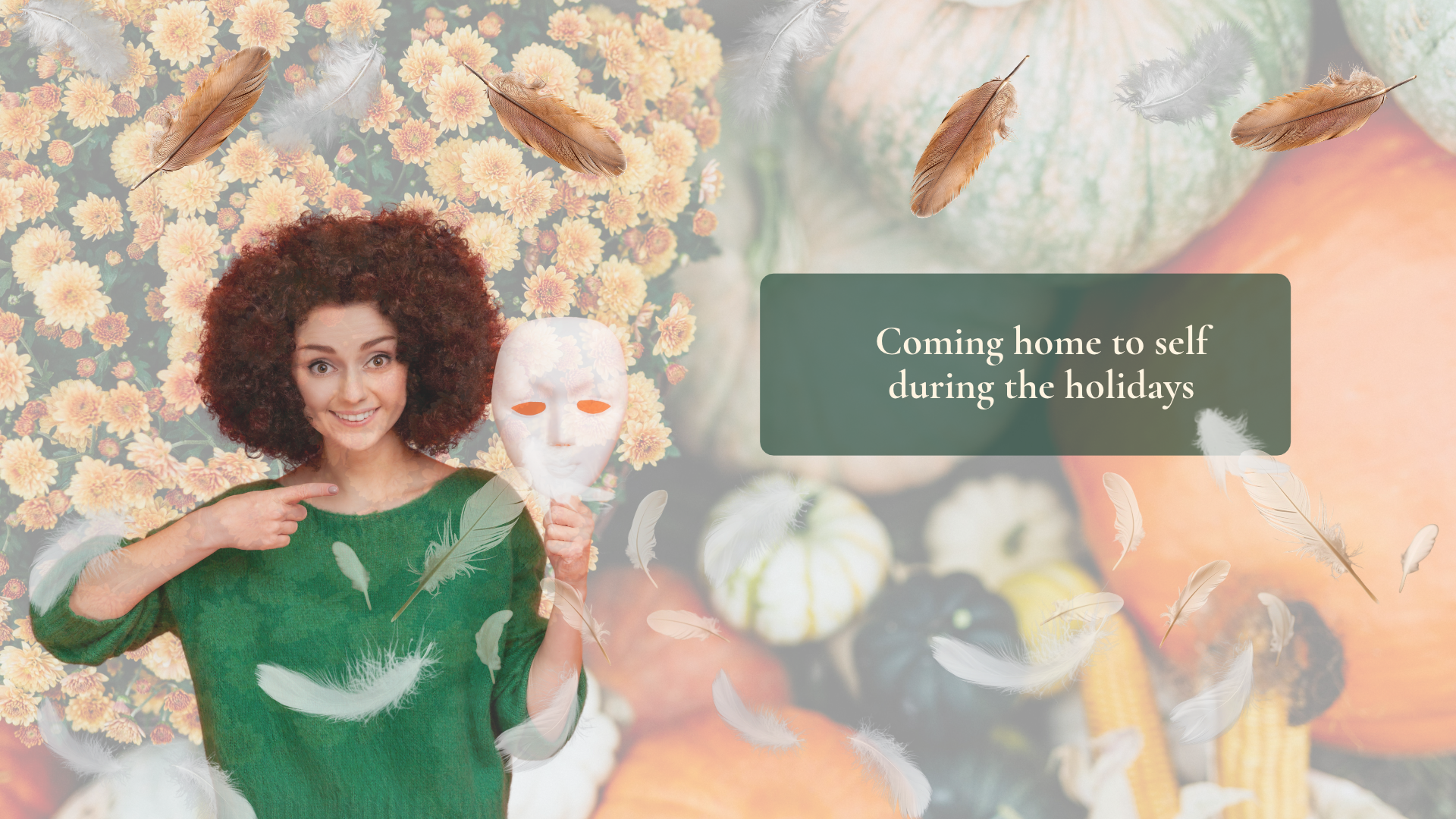
The coats go on the bed in the spare room. Someone is already in the kitchen asking where the good serving spoon went. The air smells of butter and a hot oven, and somewhere a television murmurs a game no one is really watching.
And there, in the doorway, before anyone has said hello, we feel it happen. Our face rearranges itself. Our shoulders settle into something agreeable. Our voice climbs half a note toward pleasant.
Maybe you know your version. It nods at the right moments. It laughs a beat late at the joke that wasn’t funny. It says “Oh, I’m fine, really” while something underneath quietly folds itself smaller.
That face is a mask. And I want to say something that may surprise you: masks aren’t the enemy.
What the body is doing
Masking, adjusting how we show up so we stay safe, accepted or connected, is one of the oldest things a nervous system knows how to do. (The word carries particular weight in neurodivergent communities, where its costs are especially well documented. I’m using it here in its broader sense.)
Long before we can put it into words, the body is reading the room. Stephen Porges calls this neuroception: a quiet, constant scan for cues of safety or threat in faces, voices and tone. When it senses that being fully ourselves might cost us belonging, the body often chooses belonging. The therapist Pete Walker named one version of this the fawn response, soothing and accommodating others to keep ourselves safe. It isn’t always a weakness. It might be a strategy, often learned early, and often at a table not unlike this one.
The trouble is the bill. Research by psychologist James Gross and colleagues suggests that suppressing what we feel, rather than letting it be, may come at a cost: a body that stays more keyed up, a blurrier memory of the moment, and sometimes less connection with the very people we’re masking for. Many of us know this bill by other names. The headache on the drive home. The two days of feeling hollow afterward. Maybe there is an internal whisper, inducing a small amount of shame shame by asking “Why can’t you just be normal around them?”
So the question this season isn’t whether to mask. It’s when.
When the mask may be wisdom
Sometimes masking is self-preservation. When someone at the table isn’t safe to be honest with. When a conversation would cost far more than it could ever give back. When you simply don’t have the capacity today, and smiling and passing the gravy is a decision rather than a disappearance.
There’s no shame in that. Choosing the mask, knowingly, is not the same as hiding. It’s a boundary you hold on the inside.
When the mask becomes self-abandonment
Sometimes the mask stays on long after it stopped protecting us. When you say yes to what your body is clearly saying no to. When you leave every gathering a little smaller than you arrived. When you can no longer tell the difference between keeping the peace and keeping yourself quiet.
This is where shame tends to do its best work, convincing us that our needs are the problem rather than the signal.
Setting the mask down might look like a boundary said out loud: “I’m not going to talk about that today.” It might mean being a little controversial, and letting someone be disappointed in you without rushing to fix it. It might mean arriving late, leaving early, or taking a walk around the block between dinner and pie. And sometimes it means not going at all. That choice can carry grief and guilt, and it can still be the right one.
None of these is the correct answer. Only you can feel which one keeps you whole.
The season underneath
The holidays arrive in the northeast during the thinning part of the year. The light leaves earlier each afternoon, and the land pulls its energy down into the roots to wait out the cold. Nothing in nature apologizes for this. The oak doesn’t keep its leaves to be polite.
It's a natural time to explore what we're carrying and to ask whether it was ever ours to carry. The oak lets what is no longer useful fall away, while holding on to what it needs for its long winter rest, so it can wake in spring as its truest self. We can do the same, setting down what isn't ours and gathering back what we'd like to bring home to ourselves before the long dark.
A small practice before you go
Before you walk in, or before you decide whether to walk in at all, take one quiet minute.
Rest a hand somewhere that feels steadying: your chest, your belly, the side of your face.
Let your exhale be a little longer than your inhale, two or three times.
Picture the gathering. Not the whole day, just the doorway.
Ask your body, not your mind: Is this a place where I can set some of the mask down, or a place where I need it?
Notice the answer. A softening, a tightening, a sigh. Trust it a little more than you usually would.
You can return to this in the car, in the hallway, or in the bathroom, that great unsung holiday sanctuary.
Choosing on purpose
Whatever you choose this year, you’re allowed to choose it on purpose. That, more than any perfect boundary, is where self-abandonment begins to loosen its grip. If you mask, let it be your conscious choice. If you set it down, let it empower you.
If this season stirs up more than you’d like to hold alone, a free 15-minute discovery call is a gentle place to start.
