

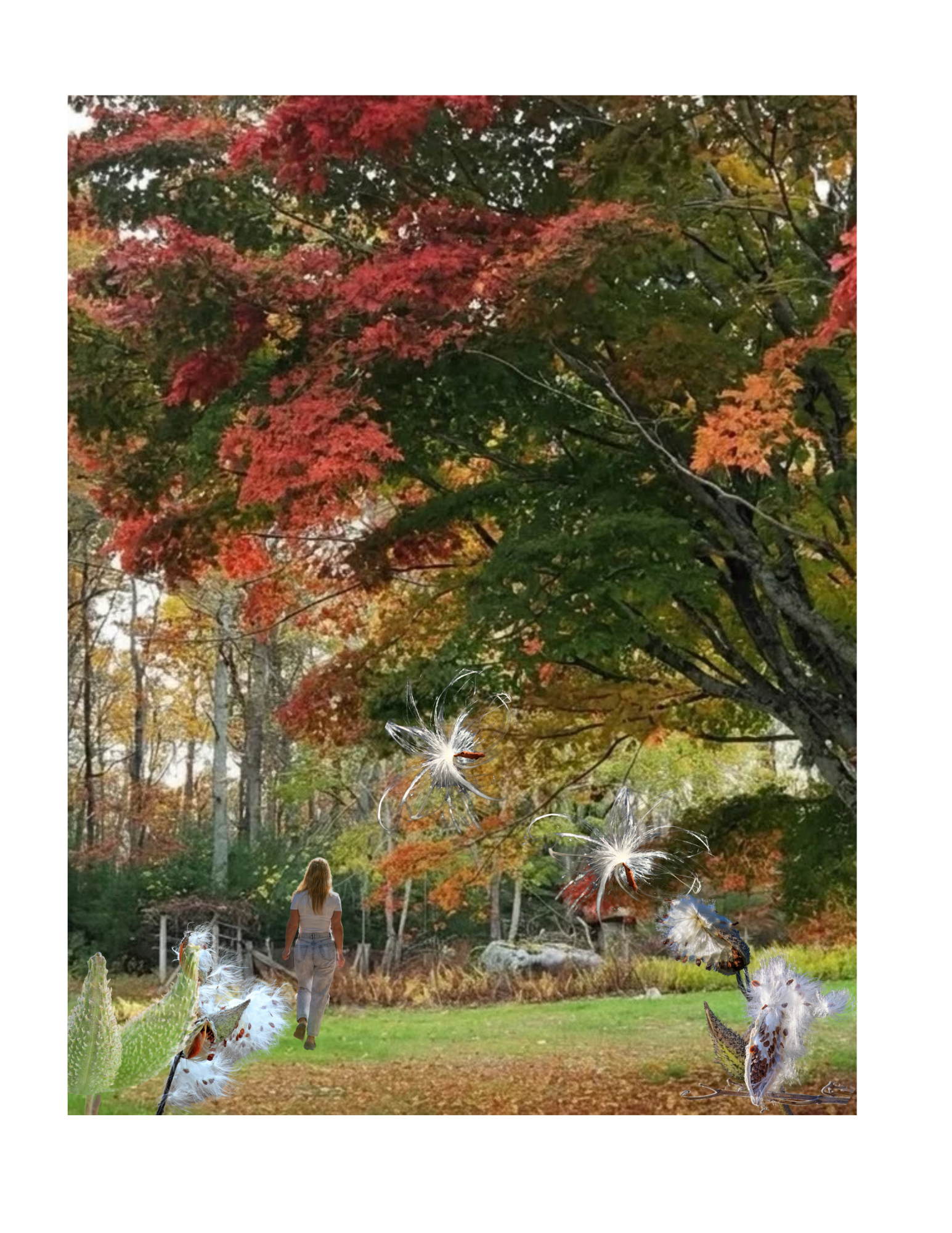
The light leaves earlier now.
By mid-afternoon the woods behind my house have already begun to dim, the oaks holding their last brown leaves as if they haven't quite decided to let go. The ground is soft and loud at the same time; every step announces itself. The air has that particular November smell, damp leaves and cold stone and something faintly sweet underneath, that I've never found a word for.
Most afternoons, I don't notice any of it. I'm walking from the car to the door with my arms or thoughts full. I'm thinking about a client, checking my phone, planning dinner, already three tasks ahead of where my feet are. November could pass me by entirely while my attention is somewhere else if I let it.
It's easy to love the outdoors in summer, when the weather practically pushes us out the door. November asks for something quieter. And there's a word I've been carrying with me lately that keeps asking me to pause.
Friluftsliv (free-LOOFTS-leev). Norwegian for "free-air-life."
The word first appeared in an 1859 poem by Henrik Ibsen, though the way of living it describes is far older. In Norway it means something deceptively simple: that time spent outdoors isn't an activity, an achievement, or a box on a wellness checklist. It's part of being alive. A walk after supper. Coffee on the step in a heavy coat. Sitting on a fallen log long enough for the chickadees to forget you're there.
There's no gear required, no distance to cover, nothing to post about afterward. There’s no agenda. That last part may be the most radical thing about it.
Somewhere along the way, many of us turned even nature into a task. We hike for the step count. We meditate in the forest and grade ourselves on whether we did it right. We go outside to be better. Friluftsliv quietly sets all of that down. It doesn't ask you to improve anything. It only asks you to be there. (It's a close cousin of another practice I love, the Dutch art of doing nothing, Niksen, but that's a story for another post.)
What happens when we simply step outside
Indoors, our attention can easily narrow. We focus hard on screens, faces, problems, lists: the kind of concentrated attention that's useful, and also tiring. A nervous system that stays in that mode all day can start to feel braced, even when nothing is wrong. Over time, that bracing can become a habit, one that feeds our sense of vigilance rather than easing it.
Outside, something different tends to happen. Psychologists call it soft fascination: the gentle way moving leaves, water, clouds or birdsong hold our attention without demanding it. The mind gets to rest while staying awake. When our eyes widen to take in the whole landscape, sky and treeline and the movement at the edges, we engage something very old in us called the orienting response: the instinct to look around and check that we're safe. When the answer comes back yes, nothing here is hunting you, the body often softens on its own. The shoulders drop. The jaw loosens. The breath lengthens without being told to.
Research is beginning to put numbers to what friluftsliv has always understood. In a 2019 University of Michigan study, people who spent 20 to 30 minutes in nature, without their phones, showed meaningful drops in the stress hormone cortisol. Another 2019 study of nearly 20,000 people found that those who spent about two hours a week in natural settings, even spread across several short visits, were more likely to report good health and wellbeing.
Twenty minutes. A couple of hours a week. Not a retreat. Not a trek. Just a life with a little more open air in it.
The dark half of the year
In the old Celtic calendar, Samhain or Halloween, marks the turning into the dark half of the year: the season of rest, of drawing in, of the land going quiet. It's tempting to treat that as a reason to stay inside until April.
Consider that the dark half isn't a season of absence. The woods are still full of life; it has simply slowed down and moved closer to the ground. Our bodies, too, are wired to read the season: the earlier dusk, the cooler air, the changing light. When we spend the whole winter under electric light, we miss many of the signals our nervous systems use to understand where we are in the day, and in the year. Close to the ground. Rooted. The place where safety is sought and can be found.
This is also the season when, beneath the surface, things begin. Like seeds resting in cold soil, the hopes we hold for our home lives, our work, and our relationships are quietly taking root. It's a thoughtful, gentle time of year, full of inner activity that moves at its own pace.
Many of us claim a favorite season and simply endure the rest, which can keep us from discovering what the other seasons have to offer. I am in New England and it is rapidly cooling. The pace slows. Friluftsliv in November doesn't mean loving the cold. Norwegians like to say there's no bad weather, only bad clothing. It means meeting the season briefly, with curiosity, and letting your body be somewhere rather than everywhere at once…with the right clothing or rather, the right tools.
In my work, I've found that easing discomfort rarely begins with avoiding it. More often, it begins with leaning in, gently and with curiosity, so we can understand what we're actually experiencing. And once we understand it, we can choose the tools that truly help: tools that support understanding, growth, and healing.
I'd encourage you to explore your own relationship with friluftsliv: time outdoors with no agenda other than just being outside. Here's one simple way to begin.
A practice to try: Arrive, Orient, Listen, Exhale
Try this the next time you're outside. Your yard, a park bench, or the edge of a parking lot with one stubborn tree all count. It takes about two minutes.
Arrive. Stand or sit still. Feel your feet on the ground, and let your weight settle down into the earth. Notice the connection there, at the bottoms of your feet.
Orient. Slowly turn your head and let your eyes wander. Don't search for anything; just notice. A branch. A color. The sky. Let your gaze rest wherever it wants to land.
Listen. Find the farthest sound you can hear. Then the closest. Then the space in between.
Touch. If you can, rest a hand on something living: bark, moss, a cold stone, the grass.
Exhale. Breathe in through your nose, and let the out-breath be a little longer than the in-breath. Three times, like a sigh you're allowed to take.
Then notice: is anything even slightly different? Your shoulders, your jaw, your breath? There's no right answer. Noticing is the practice.
Carrying it with you
I don't think friluftsliv is really about becoming an outdoorsy person. I think it's about remembering that we were never separate from the natural world to begin with. We aren't visitors to it. We're part of it, and our nervous systems have never forgotten that, even when our calendars have.
This week, I invite you to take one small, unremarkable walk. No destination. No podcast. No goal. Just you, the shortening light, and the open air.
I'd love to hear where you went.
If you're curious about gentle, body-based ways to support your nervous system, I offer a free 15-minute discovery call. You can book one at dawnchristinepathways.com.
