


EFT & TFT Tapping Protocols
Two powerful, evidence-informed approaches to nervous system regulation — working with the body's own energy system to release stress, trauma, and emotional blocks at their root.
When Talking About It Isn't Enough
For many people navigating anxiety, trauma, or chronic stress, there comes a point where insight alone stops being enough. You understand why you feel the way you feel. You can trace the origins. You've talked about it, analyzed it, processed it — and yet the feeling itself remains stubbornly, physically present.
This is not a failure of willpower or intelligence. It is simply the nature of how stress and trauma are stored — not just in the mind, but in the body's energy system, its nervous pathways, and its deeply conditioned patterns of response.
Trauma may be stored as a bodily memory, which is why treatments that utilize somatic interventions — working directly with the body rather than relying solely on cognitive processing — are increasingly recognized for their clinical advantages in trauma rehabilitation.
EFT and TFT tapping protocols offer exactly that — a gentle, body-centered approach that works simultaneously with the mind and the nervous system to release what talk therapy alone sometimes cannot reach.

What Are EFT and TFT?
Both Emotional Freedom Techniques (EFT) and Thought Field Therapy (TFT) belong to a family of practices known as energy psychology — therapeutic approaches that combine elements of modern psychology with the ancient principles of acupressure and Traditional Chinese Medicine.
Both TFT and EFT involve tapping on specific points on the body while focusing attention on a specific emotion or problem, using mostly the same tapping points, with the shared purpose of overcoming negative thoughts and traumatic memories.
Together, they share a common foundation: the understanding that emotional distress creates disruptions in the body's energy system, and that by stimulating specific meridian points through gentle fingertip tapping — while simultaneously holding a thought, feeling, or memory in awareness — those disruptions can be cleared, allowing the nervous system to return to a state of balance and ease.
-

Thought Field Therapy (TFT) — The Original Tapping Protocol
Thought Field Therapy was developed by clinical psychologist Roger Callahan, who drew on innovative applications of kinesiology and meridian therapies. It is widely regarded as the grandfather of all modern tapping therapies — the original from which EFT and many other approaches were later derived.
TFT works with the concept of a thought field — the energetic field generated in the body when a specific thought, memory, or emotion is brought to mind. When this field is disturbed by unresolved emotional experiences, it creates what Callahan called perturbations — disruptions that manifest as anxiety, fear, trauma responses, and other forms of emotional distress.
What makes TFT distinctive is its use of specific tapping algorithms — precise sequences of meridian points tailored to different categories of emotional distress. Rather than using a single generalized sequence for every issue, TFT provides a different set of unique tapping patterns for each problem category, using different tapping sequences for different triggers or emotions. This makes it a highly targeted, individualized approach — one that can be calibrated with considerable precision to the specific emotional experience being addressed.
In 2016, the Substance Abuse and Mental Health Services Administration added Thought Field Therapy to the National Registry of Evidence-Based Programs and Practices to treat stress-related disorders and trauma.
-

Emotional Freedom Techniques (EFT) — The Accessible Evolution
EFT was developed by Gary Craig, a student of Roger Callahan, as a more streamlined and accessible adaptation of TFT. Where TFT uses specific sequences for specific issues, EFT combines elements of cognitive and exposure therapy with acupressure, using fingertip percussion to stimulate acupuncture points.
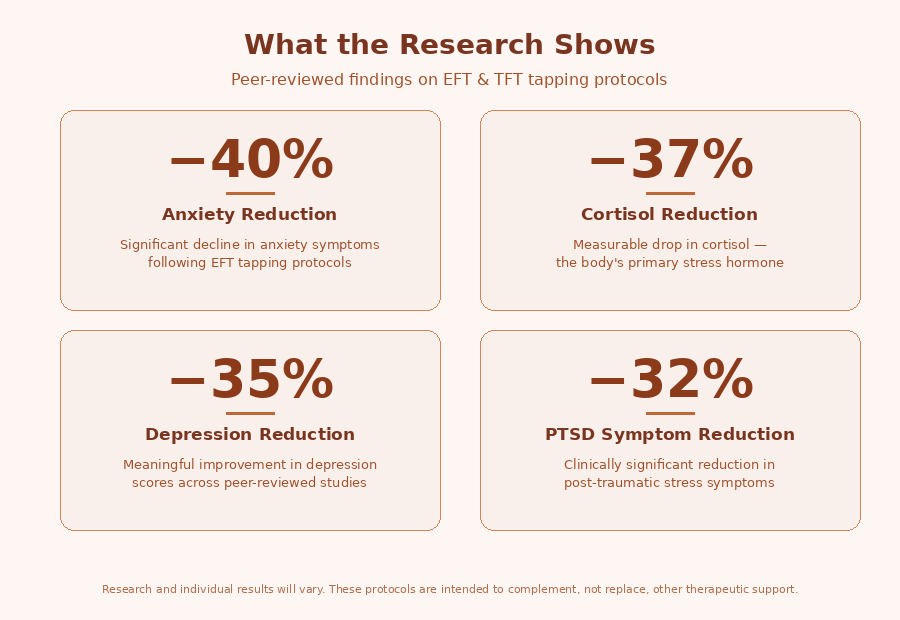
EFT's simplified approach makes it particularly well suited to self-practice between sessions — and its research base is now one of the most robust of any energy psychology method. Over 100 studies have been published in peer-reviewed journals demonstrating EFT's efficacy, with significant declines found in anxiety, depression, post-traumatic stress, and pain.
EFT sends calming signals to the amygdala — the brain's threat center — helping to quickly shift the body from fight-or-flight into a state of calm. This happens not through analysis or effort, but through the direct stimulation of the body's own nervous system pathways — making it one of the most immediate and accessible tools available for nervous system regulation in everyday life.
One of EFT's most valuable qualities is that once learned, it becomes a tool you carry with you always — something you can use independently, between sessions, in moments of acute stress, or as a daily practice of emotional self-regulation and resilience building.
What These Protocols Can Help With
EFT and TFT tapping may be supportive for those navigating:
Trauma and PTSD — including complex, developmental, and acute trauma
Anxiety, panic, and chronic worry
Depression and emotional flatness
Phobias and specific fears
Chronic stress and nervous system dysregulation
Emotional overwhelm and difficulty regulating feelings
Chronic pain and stress-related physical symptoms
Insomnia and sleep disturbances
Low self-worth and self-limiting beliefs
Grief, loss, and unresolved emotional experiences
Anyone who feels stuck despite other forms of therapy
What to Expect from a Session
Sessions are offered entirely remotely, meaning you can receive this support from the comfort and safety of your own home. This is particularly valuable for these protocols — being in a familiar, comfortable environment allows your nervous system to feel safer, which supports deeper and more effective work.
In a session, we begin by identifying the specific thought, feeling, memory, or physical sensation you would like to address and rating its intensity. We then work through a guided tapping sequence — either a TFT algorithm tailored to your specific experience, or an EFT sequence — while you hold the issue gently in your awareness. Most people notice a meaningful shift in the intensity of the feeling within a single session, sometimes within minutes.
You will also be guided in how to use these techniques independently between sessions, so that tapping becomes a tool you can reach for whenever you need it — not just something that happens in a scheduled appointment.
No prior experience is necessary. These protocols are gentle, non-invasive, and entirely led by your own comfort and pace.

How Tapping Works Alongside Other Therapies
One of the most compelling qualities of EFT and TFT is how naturally they integrate with other healing modalities. Rather than competing with existing therapeutic approaches, tapping tends to deepen and accelerate them — creating a more regulated nervous system baseline that makes other therapies more accessible and effective.
These protocols pair particularly well with somatic therapies such as EMDR, Somatic Experiencing, and Internal Family Systems (IFS), the Safe and Sound Protocol (SSP) and Rest and Restore Protocol (RRP), somatic mindfulness practices and nervous system yoga, talk therapy including CBT, DBT, and trauma-focused approaches, and any other body-centered or mind-body healing work.
A Note from Dawn
What I love most about tapping — both EFT and TFT — is how quickly it can create a genuine felt shift. Not just a cognitive reframe or a moment of insight, but an actual, physical change in how something feels in the body. That shift is real, and it is yours — not dependent on any particular insight from me or any particular breakthrough in the session. It belongs to your nervous system.
These protocols have a special place in my practice because they are among the most empowering tools I know. You don't just receive the benefit in session — you take the skill home with you. And there is something quietly profound about that.