

Rooted Words: Selenophile~ Love of the Moon
What the Moon Can Teach Us About Healing, Cycles, and the Art of Ritual
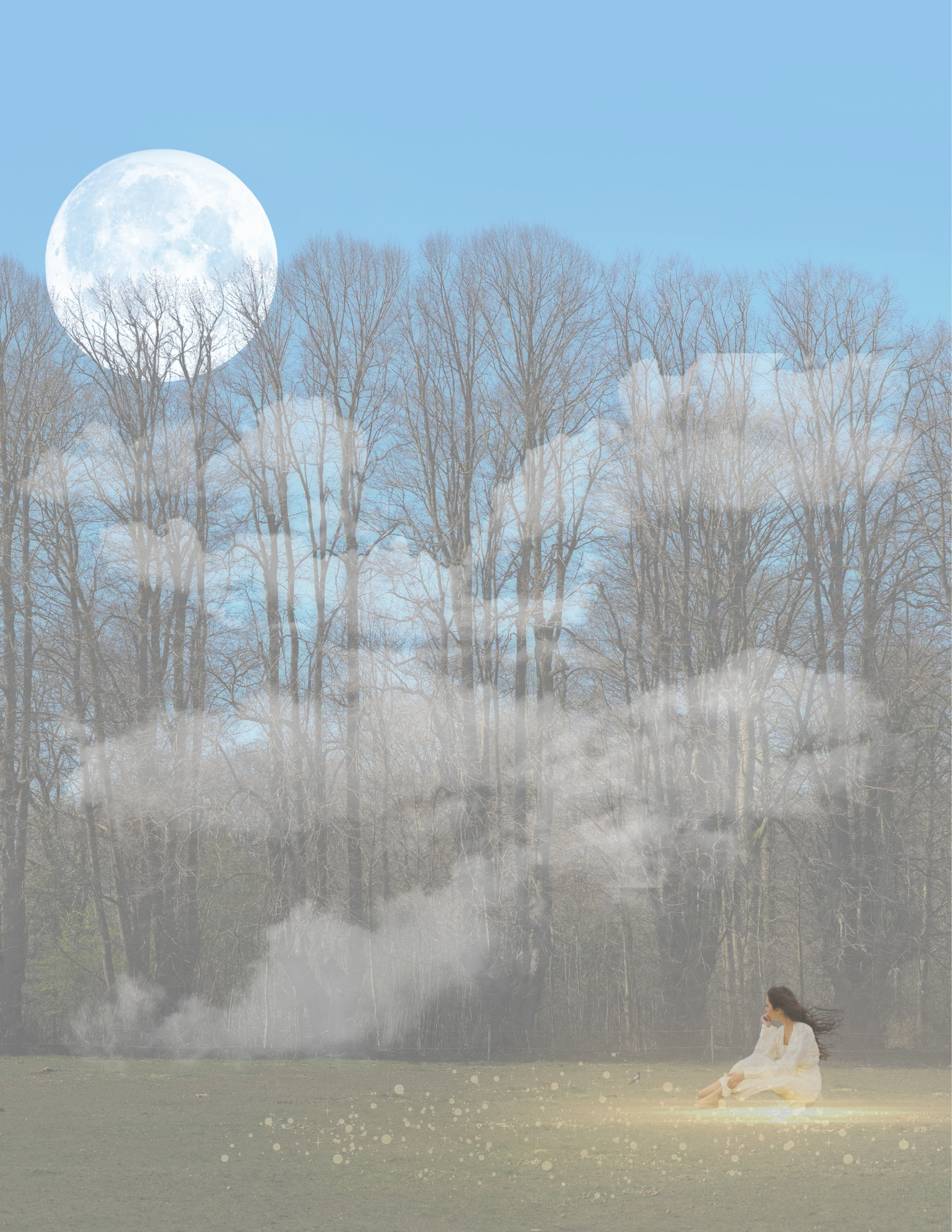
The moon just did something it does rarely. We had a blue moon this past Saturday night— depending on the weather in your sky that night, the blue moon appeared larger than it seemed like it should be, and I found myself doing what I always do when the sky asks for it: I stopped. I stood still. I looked up.
Maybe you felt it too - a pull, that quiet sense of being watched or held by something ancient. If so you might be what the Greeks called a selenophile. From Selene, the Greek goddess of the moon, and philos — lover. Quite simply: a lover of the moon. Someone who turns toward it instinctively, who notices when it's full, who feels something shift inside when the night sky is illuminated that way. There's something validating about having a word that expresses the communal appreciation for an element of our everyday, such as admiration for the lunar cycle. It’s particularly meaningful when that word has ancient origins, reflecting a practice held across centuries. Can you sense a bit of belonging when you consider the concept of a shared practice expressed by humans for as long as they have been looking up? There is so much about our modern lives that can contribute to feelings of isolation but there are opportunities, such as moon gazing, that remind us that we belong to those who also appreciate the wondrous.
The Moon as the Subconscious
Long before psychology had language for the interior life or the subconscious, the moon was already tending it.
What the sun illuminates — the visible, the rational, the known — the moon holds differently. It governs tides and dreams and the slow-circling movement of things that don't resolve quickly. In many traditions, ancient and ongoing, the moon has always represented what lives beneath the surface: instinct, feeling, memory. The vast interior territory that operates below what we can consciously name or see.
This resonates deeply with the work I do. So much of what I hold space for in sessions is exactly this — the parts of us that live below the waterline. Nervous system responses that happen before thought. Body memories that don't follow a rational timeline. The knowing that doesn't come from the mind but from somewhere older and quieter.
The moon, in this way, feels like a fitting companion for healing that unfolds slowly, in the dark as much as the light, in ways that can't always be measured or explained.
The Phases as a Map
What I love most about the moon is that in the most basic way, it reminds us of that duality: change is a constant . It waxes and wanes. It disappears entirely, then returns. It is sometimes full and overwhelming and sometimes so thin it is barely there at all. And still — reliably, patiently — it comes back around.
New Moon. Invisible, turned inward. An emptying. An invitation to begin again without the pressure of being seen. Something is forming, but it isn't ready yet, and that is perfectly fine.
Waxing. Growing, slowly and without rushing. Building toward fullness in its own time.
Full Moon. Complete illumination. Everything visible, nothing hidden. For some this feels expansive — alive, electric, energized. For others it feels like too much at once; too bright, too loud, too exposed. Both responses are entirely valid.
Waning. The gentle release. The graceful letting go of what has been held long enough. Making room for what comes next.
It’s interesting to consider the phases of the moon and what they mean with the unfolding of healing. We have our own new moons — our quiet, withdrawn periods when something is forming beneath the surface and we are not yet ready to be seen. We have our full moons — moments of overwhelm when everything feels like too much. And we have our waning times, when we are slowly releasing something we've carried far longer than we realized. Healing, like the moon, moves in cycles. Though it is not always as predictable as the phases of the moon, we do tend to circle back (see this post for more info). Sometimes we darken and brighten and then darken again. This is not a sign that something has gone wrong. This is simply the nature of all things.
The Value of Ritual
Here is something I have come to believe, both in my work and in my own life: the nervous system loves predictability. It’s true that it’s healthy to challenge our comfort zones wisely. This practice can build capacity and enhance our life experiences for the better, but when there has been trauma, we heal when we begin to feel safe. Our nervous system finds safety in rhythm, in repetition, and in knowing what comes next. This is one of the quieter reasons ritual matters — not as performance or superstition, but as something our bodies actually need. A small, repeated act that signals inward: you are here, you are safe, this moment belongs to you. Over time, that signal becomes familiar. Familiar becomes settling. Settling becomes, slowly, a kind of home. This can take the form of enjoying a cup of coffee mindfully or taking notice of the lunar cycle.
The moon — with its reliable, unhurried cycling — offers a natural scaffold for exactly this kind of ritual. Some people set intentions at the new moon and release them at the full. Some simply step outside and look up. Some light a candle, write in a journal, make a slow cup of tea while moonlight comes through the window. Some gather with others and speak what they've been carrying quietly. None of it needs to be elaborate. What matters is the returning. The small act of marking time with awareness and in a way that is yours.
A blue moon, like the one we just had, is the second full moon to appear within a single calendar month — something that happens only once every two to three years, which is where we get the phrase once in a blue moon. Some consider it a time of heightened intuition, of things surfacing that have been quietly building. Whether or not you apply symbolic meaning to the phases of the moon, there is something to be said for pausing to mark the rare and for allowing it have personal value.
A Closing Thought
If you find yourself drawn to the moon — if you slow down when it's full, if you notice the shift in light through your window, if something in you responds to its cycles — trust that impulse. It may be older and wiser than it appears. You might be a selenophile. Or you might simply be someone who is paying attention to cycles, to mystery, to the quiet intelligence of things that move slowly and keep returning regardless.
In a world that asks us to be busy, the moon gives us permission to be otherwise. We can acknowledge our own phases and the time needed to explore them. Sometimes we can be entirely dark while something new is forming or be full and radiant.
If this kind of gentle, earth-rooted reflection resonates with you, I'd love to stay connected. You're welcome to subscribe below for occasional writings, seasonal practices, and updates on upcoming offerings.
