

Trauma Healing Isn’t a Linear Process
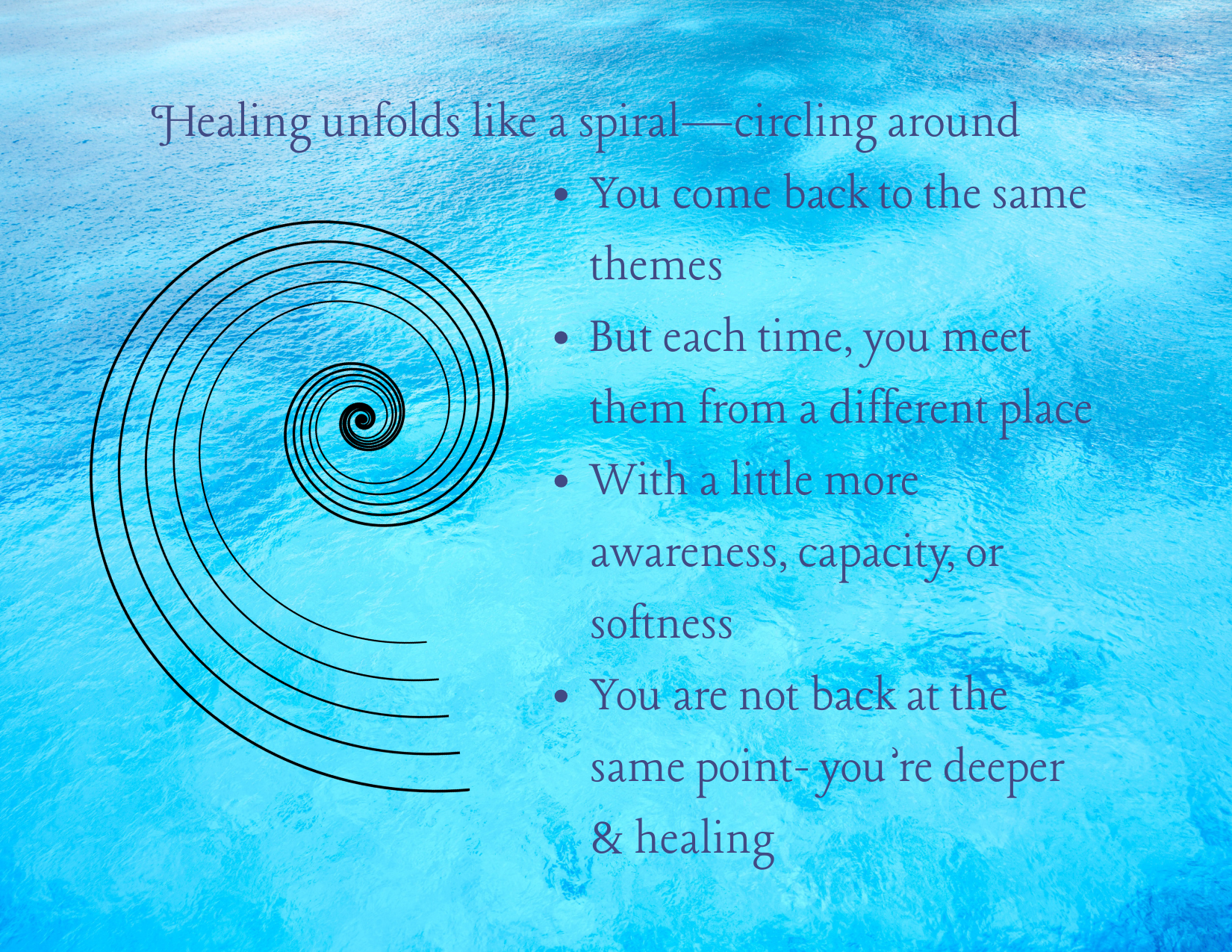
The Spiral
Most of us come to trauma healing with a secret hope we'd never say out loud: that it will move in a straight line. Even after someone has told us — maybe a therapist that we work with regularly— that healing isn't linear, we still find ourselves scanning for progress markers like we're hiking a well-tagged trail. We want the good days to stack. We want to feel ourselves moving forward. That makes sense. We measure almost everything linearly — height, income, mileage, weight, time. Forward and upward is basically the operating system of modern life.
Trauma healing works outside the dimensions of simple linear frameworks.
It doesn't move like a staircase. It moves more like the tide. Like the seasons. Like a spiral — circling back through familiar places, but each time with a little more awareness, a little more capacity, a little more grace. It goes deeper into our identities and pushes ever further outward into our connections. Here's what I want you to hear: that's not a flaw in the process. That's the process working.
The Myth of Linear Progress
We live in a culture obsessed with measurable, upward growth. Five-step plans. Productivity systems. Fitness trackers. All of it built on the assumption that progress should be consistent, visible, and moving in one direction. It the measure shows we aren’t moving forward, or worse- back, then the judgement is failure. So when healing doesn't cooperate with our impulse to see things moving in order like the marked inches on a door frame growth record kept in pencil, the conclusions we draw are predictable:
I thought I was past this. Why is this happening again? I was doing so well. What am I doing wrong?
Often, someone around us helpfully echoes those thoughts back — which adds a lovely extra layer of shame to something that's already tender.
But here's the thing: trauma isn't stored in a timeline. It lives in the nervous system — in reflexes and protective patterns that once helped you survive; maybe from when we were very young or from an abusive relationship that we had as an adult, or both. Those patterns don't disappear all at once. They soften in layers. So when something surfaces again, it's rarely regression. More often, it means your system finally has enough safety to process what it couldn't before.
That's not failure. That's capacity expanding. Those are very different things.
How the Nervous System Actually Heals
Healing happens in cycles. Something comes up — a sensation, a memory, a familiar emotional weather pattern — and then there's space for it to settle. Then it happens again, at a slightly different depth. This isn't a limitation of the process. It's protective intelligence. Think of it like this: stretch, integrate, rest, expand. Repeat.
What looks like a setback from the outside is often your nervous system reorganizing around a new level of stability. You're not back at square one. You're meeting familiar territory from a different point on the spiral. Maybe you noticed the trigger a little sooner this time. Maybe you recovered a little faster. Maybe — and this one's big — you reached for support instead of turning on yourself.
Those are the real markers of healing. Not the absence of hard moments, but a growing ability to stay with yourself through them.
Why Force Doesn't Work Here
If healing were linear, it would reward pushing. More effort, more discipline, more powering through — and eventually you'd arrive somewhere pain-free and unbothered.
But trauma-informed healing doesn't respond to force. It responds to safety. It asks for attunement instead of urgency. Pacing instead of pressure. Self-trust instead of self-discipline. This is why healing feels seasonal. There are stretches where things feel open and spacious. Then there are stretches where the tenderness returns and everything feels closer to the surface again. Neither means you're doing it wrong. Winter isn't a mistake because it isn't summer. Contraction isn't failure because it isn't expansion.
The rhythms are what make it sustainable.
On Safety — And Why It Can't Be Rushed
If your healing has felt slow, unpredictable, or stubbornly nonlinear, I want to gently offer this: there may be nothing wrong. Resist the temptation to judge yourself and explore the notion that your nervous system may simply be doing exactly what it's designed to do.
Healing requires safety — because your body will not release what it still believes it needs to protect you. Trauma isn't just the memory of something hard. It's the imprint of threat. And over time, a nervous system shaped by that threat learns to stay alert. It gets quicker to react, slower to trust, more reluctant to soften.
Keeping vigilant made sense once. It was smart, actually. The challenge is that the body doesn't automatically update its threat assessment just because circumstances have changed. It needs evidence. It needs repetition. It needs new experiences of steadiness, connection, and choice — accumulated slowly, over time.
Safety, after trauma, isn't a thought or concept to work through intellectually. It's something the body has to feel. And it can be rebuilt — just not on demand, and not through sheer willpower.
Where We Go From Here
In my work, we build that safety gently — through trauma-informed yoga, somatic practices, and nervous system regulation tools back by scientific research. Not pushing the process, but creating the conditions for it to unfold at a pace your system can actually integrate.
If any of this resonated, you're welcome to explore working together — or just reach out with questions. There's no pressure, no five-step plan, and no straight line. Just the spiral, and someone to walk it with you.
